加载中...

Powered by Made-in-China.com
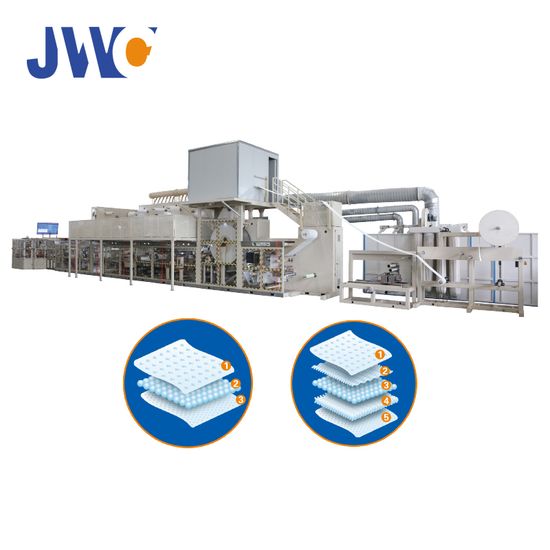
Full Servo Automatic Underpad Manufacturing Machine with CE
US$450,000.00-600,000.00
1 Set
Product profile
Customization
AvailableType
Drum TypeReal Running speed
400-500PCS/minModel NO.
JY-UPAutomatic Grade
AutomaticCertification
CECondition
NewMachine Power
Three-Phase 380V 50HzMachine Capacity
380kwAir Consumption
4000L/MinStable Production Speed
250m/MinDesigned Production Speed
300m/MinProduct Width
600-1200mmProduct Length
600-1800mmRate of Finished Product
>98%Installation Footprint Size
40*8*5mMachine Size
32*2.2*3.8mColor
OptionalTransport Package
Wooden CasesSpecification
32m*2.2m*3.8mTrademark
JingyiOrigin
ChinaHS Code
84418090Production Capacity
200 Sets Per YearKey features
High Production Speed: Designed speed up to 300 m/min with stable output of 200-220 m/min.
Full Servo Control: Features Mitsubishi servo motors and PLC for precise tension and speed control.
High Efficiency Rate: Finished product rate exceeds 98% with waste rate under 2%.
CE Certified Safety: Meets CE standards with safety switches and automatic power disconnect.
Customizable Dimensions: Product width 600-1200mm and length 600-1800mm are customizable.
Global Warranty Support: One-year guarantee with lifetime service and global technical support.
Advanced Automation: Auto-splicing, reject removal, and fault diagnosis via touchscreen.
Premium Components: Uses NSK bearings, Optex sensors, and Airtac pneumatic units.
Company profile


Business Type: Manufacturer/Factory, Trading CompanyExport Year: 2010-02-01Nearest Port: Xiamen PortAverage Response Time: ≤15hTerms of Payment: LC, T/T, Western Union, etc.International Commercial Terms(Incoterms): FOB, EXW, CFR, CIF
AI-Powered supplier vetting
SummaryQuanzhou Jingyi Machinery Co., Ltd. is a China-based limited company in Fujian described as both a trading company and manufacturer/factory, offering tissue-paper machinery and production lines. It reports ISO 9001 and ISO 14001 certifications, annual machinery capacity of 80 toilet-paper machines, 30 facial-tissue machines, and 100 napkin-paper machines, plus broad customization services. However, the supplier reports no new products in the past year, no ODM service, no SDK, and no OEM service for popular brands. The supplier has three employees, no cooperative suppliers listed, and no valid import/export license stated. Audit information identifies BV as the auditing organization, with a report period from June 11, 2025 to June 10, 2026, but the audit result is recorded as 0 without explanatory detail. Evidence is insufficient to verify after-sales capability, customer cases, or financial strength.
CertificationsThe supplier reports ISO 9001 and ISO 14001 management-system certifications. A BV audit is also recorded with a report period from June 11, 2025 to June 10, 2026, although the audit result is listed as 0 without an explanation that permits a positive interpretation.
R&D capabilityThe supplier reports no new products in the past year, no ODM service, and no available SDK. It does report total R&D engineer experience of 6–10 years, but the stated lack of recent new-product development and SDK availability indicates limited demonstrated innovation capability.
Production capacityThe supplier offers multiple tissue-paper machines, production lines, cutting equipment, and packing machines, and reports annual capacity of 80 toilet-paper machines, 30 facial-tissue machines, and 100 napkin-paper machines. Its manufacturer/factory classification supports production involvement, although the three-employee headcount and absence of additional operational detail warrant verification of actual capacity.
Customization capabilityThe supplier explicitly lists customization from samples, customization from designs, full customization, minor customization, and flexible customization in both R&D/design-related and general capability information. This is direct evidence of broad customization offerings.
Product Q&A
Q:What is the production speed of the machine?
A:
The designed production speed is 300 m/min, with a stable production speed of 200-220 m/min under standard conditions.
Q:What is the warranty period for this machine?
A:
We provide a one-year guarantee with lifetime service support from our technical team.
Q:Can the product size be customized?
A:
Yes, the product width is customizable from 600-1200mm, and the length is customizable from 600-1800mm.
Q:What brands are used for the main components?
A:
Key components include Mitsubishi PLC and servo motors, Optex sensors, NSK bearings, and Airtac pneumatic units.
Q:What is the power consumption of the machine?
A:
The machine capacity is 300Kw, operating on Three-Phase 380V 50Hz power supply.
Send Inquiry
*To:Quanzhou Jingyi Machinery Co., Ltd.
Quanzhou Jingyi Machinery Co., Ltd.*Content:
Supplier replies will be sent to your registered email
You may also like

Womeng Full Servo Sanitary Napkin Production Line Under Pad Making Machine
US$300,000.00-400,000.00
1 Set(MOQ)


High Efficiency Underpad Full Automatic Making Machine PLC Control with CE
US$300,000.00-500,000.00
1 Piece(MOQ)

Welldone Full Automatic CE Certified Woman Sanitary Napkin Making Machine Line
US$380,000.00
1 Piece(MOQ)

2026 New Full Servo Under Pad Making Machine PLC Control Professional Customization
US$300,000.00-550,000.00
1 Piece(MOQ)

Full Automatic Women Sanitary Napkin Pad Making Machine Production Line with CE
US$350,000.00-450,000.00
1 Piece(MOQ)

Welldone Full Automatic Disposable Adult Pants Diaper Manufacturing Machine
US$530,000.00
1 Piece(MOQ)

Welldone Efficient Full Automatic Adult Incontinence Diaper Manufacturing Machine
US$530,000.00
1 Piece(MOQ)

Jwc-Cfd-Sv Full Servo Pet Pad Production Line Under Pad Machine
US$500,000.00-650,000.00
1 Piece(MOQ)

Manufacturing Full Servo Women Lady Sanitary Napkin Making Machine Line
US$320,000.00-340,000.00
1 Piece(MOQ)

Welldone Full Automatic CE Woman Sanitary Napkin Pad Making Production Machine
US$450,000.00
1 Piece(MOQ)

High-Speed Customized Full-Servo Sanitary Napkin Machine Equipped with Suspension Technology
US$212,000.00-472,000.00
1 Piece(MOQ)

Semi Full Servo Automatic Second Hand Used Under Pad Sanitary Napkin Adult Baby Diaper Production Line Making Machine
US$7,000.00-700,000.00
1 Piece(MOQ)

Full Servo Sanitary Napkin Making Machine Automatic Pad Production Line
US$163,000.00-363,000.00
1 pieces(MOQ)

5 & 3 Layers Under Pad Puppy Pad Machine with Good Price and Quality
US$380,000.00-450,000.00
1 Piece(MOQ)

Stable Full-Servo Control Sanitary Pad Making Machine with Ce (HY800-SV)
US$99,000.00-990,000.00
1 Set(MOQ)

Full Servo Sanitary Napkin Machine Price, Automatic Sanitary Pad Machine Price
US$195,000.00-389,000.00
1 Piece(MOQ)

High Speed Full Servo Disposable Pet Pad Machine with CE
US$450,000.00-600,000.00
1 Set(MOQ)

Servo Stabilized Sanitary Napkin Making Machine with Minimal Maintenance Downtime
US$230,000.00-250,000.00
1 Set(MOQ)

Full Automatic High Speed Servo Control Women Maxi Sanitary Napkin Pads with Wings Making Machine
US$190,000.00-420,000.00
1 Set(MOQ)
CE, SGS 2022 Jwc Containers China Pet Under Pad Machine
US$500,000.00-650,000.00
1 Piece(MOQ)